Block Grabber vs Instant Offer Bot: Which Is Safer for Your Amazon Flex Account?
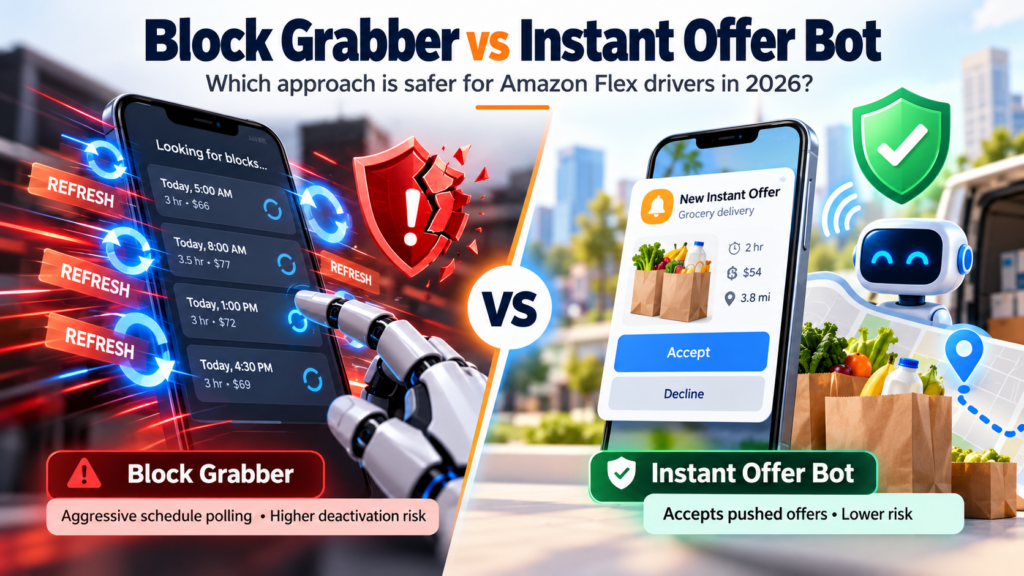
A block grabber is not “safe” in the way most drivers hope. It works by aggressively auto-refreshing and snatching scheduled delivery blocks faster than a human can, and that pattern is exactly what Amazon’s systems look for when they flag or deactivate accounts. An Instant Offer bot takes a different path: instead of racing for blocks, it accepts the Whole Foods and Amazon Fresh offers Amazon pushes to you when you match its targeting rules — a quieter, lower-risk pattern. This guide explains how each one works, what Amazon’s policy actually says, and which approach makes sense in 2026 if keeping your account matters more than squeezing out every block.
What is an Amazon Flex block grabber?
A block grabber (also called a flex grabber, flex swiper, or block catcher) is a tool that automatically scans the Amazon Flex app for available delivery blocks and claims them the instant they appear — far faster than tapping “refresh” by hand. Delivery blocks are the scheduled shifts drivers see in the app: a 3- or 4-hour window out of a specific station, with a set base pay. In busy markets the good blocks are gone in milliseconds, so drivers started using grabbers to win them automatically. A typical grabber:
- Polls the Flex schedule endpoint many times per second
- Filters by station, pay rate, date, and duration
- Auto-accepts any block that matches your rules
The appeal is obvious: you stop refreshing the app all day and let software catch blocks while you sleep. The problem is equally obvious to Amazon — no human refreshes the schedule 20 times a second, so the behavior is detectable.
What is an Instant Offer bot?
An Instant Offer bot automates a different part of Amazon Flex. Instant Offers are on-demand delivery offers — mostly Whole Foods and Amazon Fresh grocery orders — that Amazon pushes to nearby drivers in real time, outside the scheduled-block system. When you’re close to a store and available, Amazon sends the offer to you directly. An Instant Offer bot doesn’t race the whole market for a shared block. It watches for the offers Amazon sends to your account and accepts the ones that match your rules (pay, distance, store) before the short acceptance window closes. The key difference:
- A block grabber competes for a limited pool of scheduled blocks by polling aggressively.
- An Instant Offer bot responds to offers Amazon already decided to send you.
That distinction matters for account safety. Responding quickly to an offer that was pushed to you looks far more like normal driver behavior than hammering the schedule endpoint thousands of times an hour.
Is block grabbing against Amazon’s terms?
Yes — in practice. Amazon’s Flex Terms of Service prohibit using automated tools, scripts, or bots to access the Flex app or secure blocks, and they reserve the right to deactivate any account that does. Amazon doesn’t publish exactly how it detects automation, but the signals are not hard to guess:
- Request patterns no human could produce (dozens of schedule polls per second)
- Blocks accepted within milliseconds of appearing, repeatedly
- Activity from the same account across impossible locations or at machine-perfect intervals
No tool can promise you won’t be caught, and any vendor that guarantees “100% ban-proof” block grabbing is overselling. The honest framing is about risk level, not safe vs. unsafe:
- Aggressive block grabbing produces the loudest, most bot-like footprint — the highest deactivation risk.
- Instant Offer automation produces a quieter footprint because it reacts to offers Amazon sent you, rather than scraping the schedule — lower risk, though never zero.
If your Amazon Flex income matters, the deactivation math is simple: a few extra blocks a week are not worth losing the account permanently. That trade-off is the whole reason the market is shifting away from grabbers.
Block grabber vs Instant Offer bot: side by side
|
Factor |
Block grabber |
Instant Offer bot |
|---|---|---|
|
How it works |
Polls the schedule and grabs scheduled blocks |
Accepts Whole Foods / Fresh offers pushed to you |
|
Account risk |
Higher — bot-like polling is easy to detect |
Lower — reacts to offers Amazon sent you |
|
Earnings type |
Guaranteed block base pay |
Per-offer pay, often with tips |
|
Competition |
Races every driver in the market |
Offer is already addressed to you |
|
Best for |
Drivers chasing long scheduled shifts |
Drivers who want flexible, on-demand grocery runs |
|
Detection footprint |
Loud and constant |
Quiet and intermittent |
Both carry some risk because both automate the app. The difference is how much noise each one makes and how directly it fights Amazon’s systems. 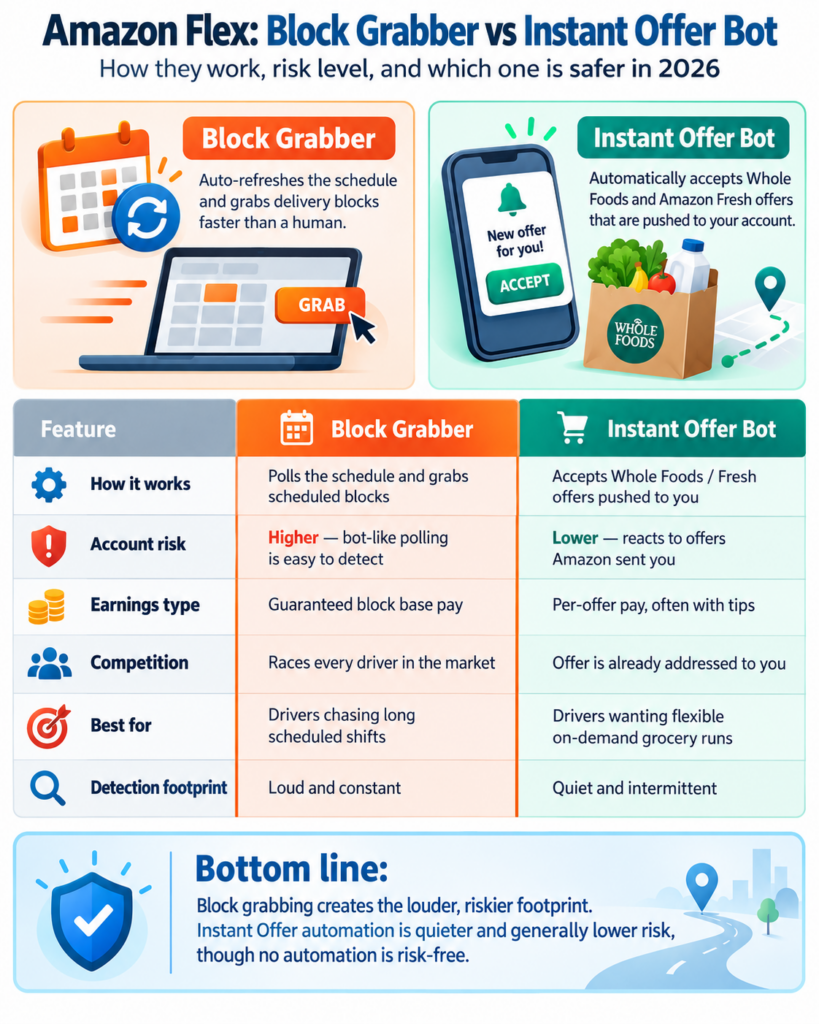
Why Flexiliti doesn’t do block grabbing
Flexiliti is built only for Instant Offers — and that’s a deliberate choice, not a missing feature. We don’t poll the schedule or race for blocks because that’s the behavior most likely to get a driver’s account deactivated. Our focus is helping you catch the Whole Foods and Amazon Fresh offers Amazon already sends you, using smart targeting and proximity rules so you only accept the runs that are worth your time. That means Flexiliti is the right tool if you want on-demand grocery earnings with a lower account-safety risk — and the wrong tool if your only goal is grabbing long scheduled blocks at any cost. It’s worth knowing where other tools stand. Several popular Amazon Flex tools — including FlexingBot and OnlyFlexer — are built around block grabbing, which is exactly the higher-risk, loud-footprint pattern described above. Others, like InstantGrabber, focus on Instant Offers, closer to Flexiliti’s approach. If account safety is your priority, it’s the block-grabbing tools you’ll want to be most careful with. See how the Instant Offer approach works on our Instant Offer Bot page, read the best Amazon Flex bots in 2026 guide, or compare the main tools side by side in our Amazon Flex bot alternatives guide.
Frequently asked questions
Is using a block grabber illegal? It’s not a crime, but it does violate Amazon Flex’s Terms of Service. The real consequence isn’t legal — it’s account deactivation, which is permanent and hard to appeal.
Will I get banned for using a block grabber? There’s no guarantee either way, but aggressive grabbers create the most detectable footprint, so they carry the highest deactivation risk. Anyone promising a “ban-proof” grabber is overselling.
Do block grabbers still work in 2026? Some do, but Amazon’s detection has tightened and many drivers have been deactivated. The trend is clearly moving toward lower-risk automation like Instant Offers.
What’s the difference between a block grabber and an Instant Offer bot? A block grabber hunts scheduled blocks by polling the schedule. An Instant Offer bot accepts the on-demand Whole Foods and Fresh offers Amazon pushes to your account — a quieter, lower-risk pattern.
Which one earns more? It depends on your market. Blocks give guaranteed base pay for a fixed window; Instant Offers are per-run and often include tips. Many drivers combine scheduled blocks they grab manually with automated Instant Offers.
Is Flexiliti a block grabber? No. Flexiliti automates Instant Offers only and does not grab or schedule blocks, by design.
We build tools for Amazon Flex drivers and share what we learn from thousands of them along the way.